Free AI Design Tools Comparison, I have spent more than two years testing different free AI design tools and I must admit that the situation has radically changed since I have first stepped into this world. My initial interest has evolved into a necessity when it comes to approaching design work, particularly when time pressure is high or the ideas are necessary to be developed in a short period of time.
The aspect of free AI design tools is that free is not necessarily equal. Others put their best features on paywalls once you have spent time learning to use them, whereas others do provide truly strong features with no cost. I will take you through what I have found out through actual usage and not the marketing pledges.
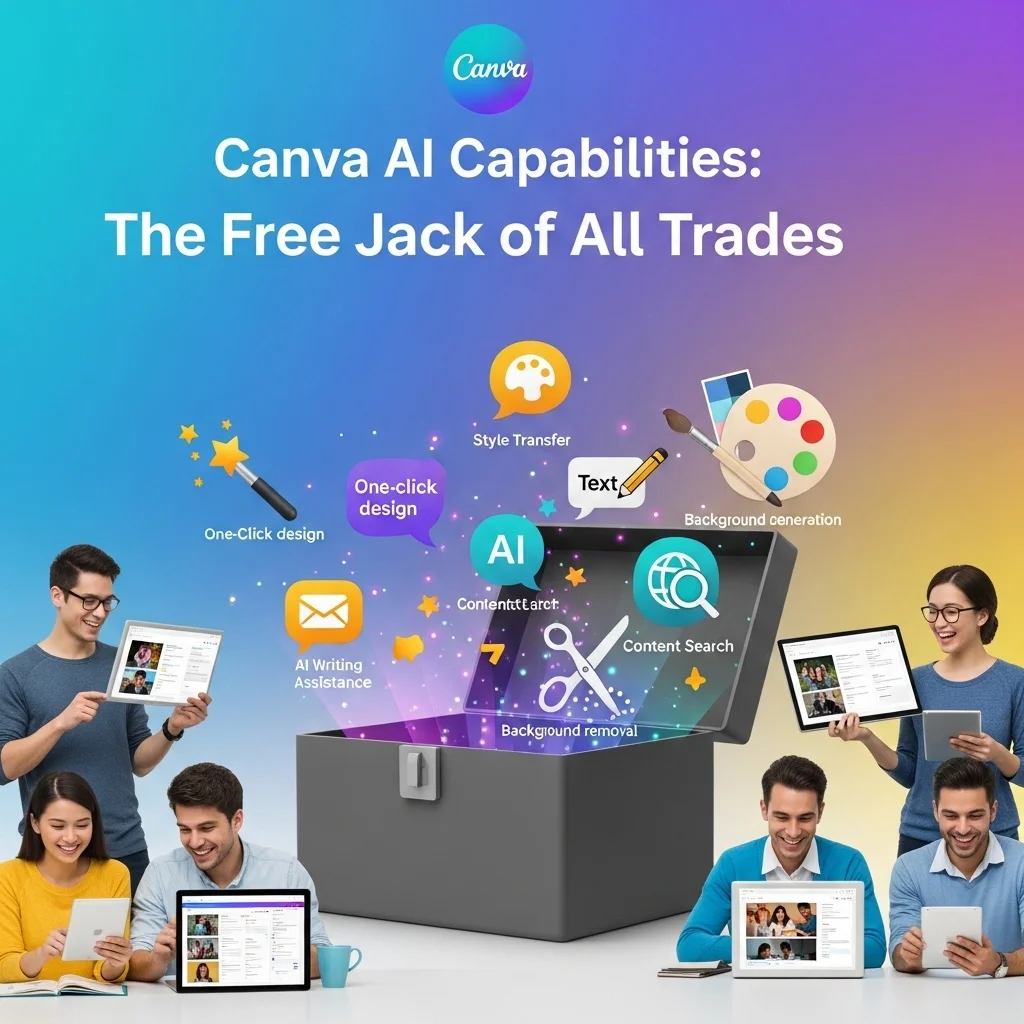
Canva AI Capabilities: The Free Jack of All Trades.
Before they added AI options, Canva was already my graphics shortcutt of choice and, as such, when Magic Design and background removal capabilities were added, I was interested but wary. And, by chance, it was not entirely unjustified.
The free plan will include Magic Eraser and background removal, but with fewer monthly credits, which are approximately 10 uses per month at the time of my last visit. This is alright when one is only making a few posts on social media. I just did that in eliminating a messy background of a product photograph to a small business of my friend and it took seconds to do the work.
The area of strength of Canva is accessibility. The interface can be characterized by the fact that my 60-year-old neighbor managed to understand it independently. The templates are truly helpful, but they have become so common that you can notice that the same design system can be used by various brands should you be paying attention.
Adobe Express: Strengths with a Price Tag.
Adobe Express (previously Adobe Spark) is similar to an effort of Adobe to democratize their professional products. The free plan also has a few definitely impressive functionalities in place, such as text effects, fast actions to remove backgrounds, and customization of templates that is more advanced than Canva in this respect.
I used Adobe Express to redesign my portfolio site header on a weekend and the text-to-template feature saved me the hours of laying out the site. You tell what you desire and it creates several layout alternatives. These were not all winners but two out of five were good places to start.
The thing is this, that Adobe would love you to upgrade. The exploitative continuous persuasion and the premium templates are locked in. On the free level of exports, watermarks are also sometimes added based on the things you have utilized, and that was something unpleasant to me initially.
The fact that it integrates with Adobe Fonts is a significant advantage in case you are concerned with typography. I have been able to use type-faces with Express which would have cost me money elsewhere, and they have given the final designs a markedly higher level.
Playground AI and Leonardo AI: Image Generators With a Purpose.
These are the tools that work in contrast to the above design platforms. They both specifically specialize in AI image generation, and they both have very generous free options.
The free plan provides about 500 pictures per day, which is plenty in most cases of people who use Playground AI. I tried it in developing concept art in an indie game project of a friend and the results were not always successful. You must learn prompt engineering which is in itself a skill. My first efforts gave surreal images that could not be used. With watching tutorials and practicing, I was able to improve the results, but it required actual effort.
Leonardo AI is a bit more polished and appears to be more consistent when dealing with generated images. Leonardo was more visually coherent than Playground when I had to come up with a series of images as a unified set of blog headers. The free version also gives 150 tokens per day which is equivalent to about 30-40 photos depending on the settings.
The unknown Workhorse: Photopea.
Although it is not an AI tool, Photopea should be mentioned as a fully free and browser-based alternative to Photoshop. It lacks flashy generative AI, however it has recently added some AI-supported features such as content-aware fill which are actually functional.
I have also employed Photopea in making a precise photo retouching which could not be done in other free applications. The interface resembles Photoshop to that the extent that I transferred my prior knowledge instantly. This is the solution to any one who requires serious editing functionality and does not want to pay subscription charges.
The Real-World Verdict
Having been tested on many different projects, big and small, nonprofit flyers and small business branding, and personal creative work, here is my objective evaluation:
- To start with, easy, and fast: Canva has the most user-friendly and competent free plan. You will end up hitting your limit some day, but it is really helpful without charge.
- To do serious work with design: Adobe Express due to their upselling, or Photopea when you have basic design knowledge, and simply require tools with power.
- In the case of AI image generation: Leonardo AI comes out as the most consistent winner over Playground, both options demand learning investment which will not be applicable to everyone.
To use on mobile: Although Picsart is rather quirky, it provides the best experience on-the-go.
The fact is that I continue using various tools based on the project. Each of the free platforms is not good at everything, and that is fine. The trick is that, you need to learn the strengths and weaknesses of each tool before you are half a way into a project.
One last consideration: the tools are changing very quickly. Functionalities that I was unable to utilize half a year ago are no longer paid, and many have shifted to paywalls. Become flexible and not attached to the current shape of a certain platform.
Frequently Asked Questions
Will free AI design tools ever become a substitute of paid software?
For many users, yes. Free tools are good in the case of basic design requirements. Paid options will still be required by professionals who require a more advanced feature and commercial license.
What is the most appropriate tool to use in social media graphics?
Canva is the simplest option; it has templates that are customized to suit all the platforms and the right size and dimensions are fixed.
Is the use of these tools dependent on design experience?
Not necessarily. Canva and Adobe Express are user friendly. Leonardo AI image generators have more difficult learning curves.
Does the AI-generated image have any copyright issues?
This varies by platform. The majority of free tools allow images generated to have rights of use although terms of service should always be checked particularly in commercial projects.
The frequency with which the free tier restrictions are modified?
Frequently. Businesses make changes in products every quarter or even every month. Something that is free today may be restricted tomorrow and therefore ensure that you confirm the current conditions before initiating huge projects.
Leave a Reply