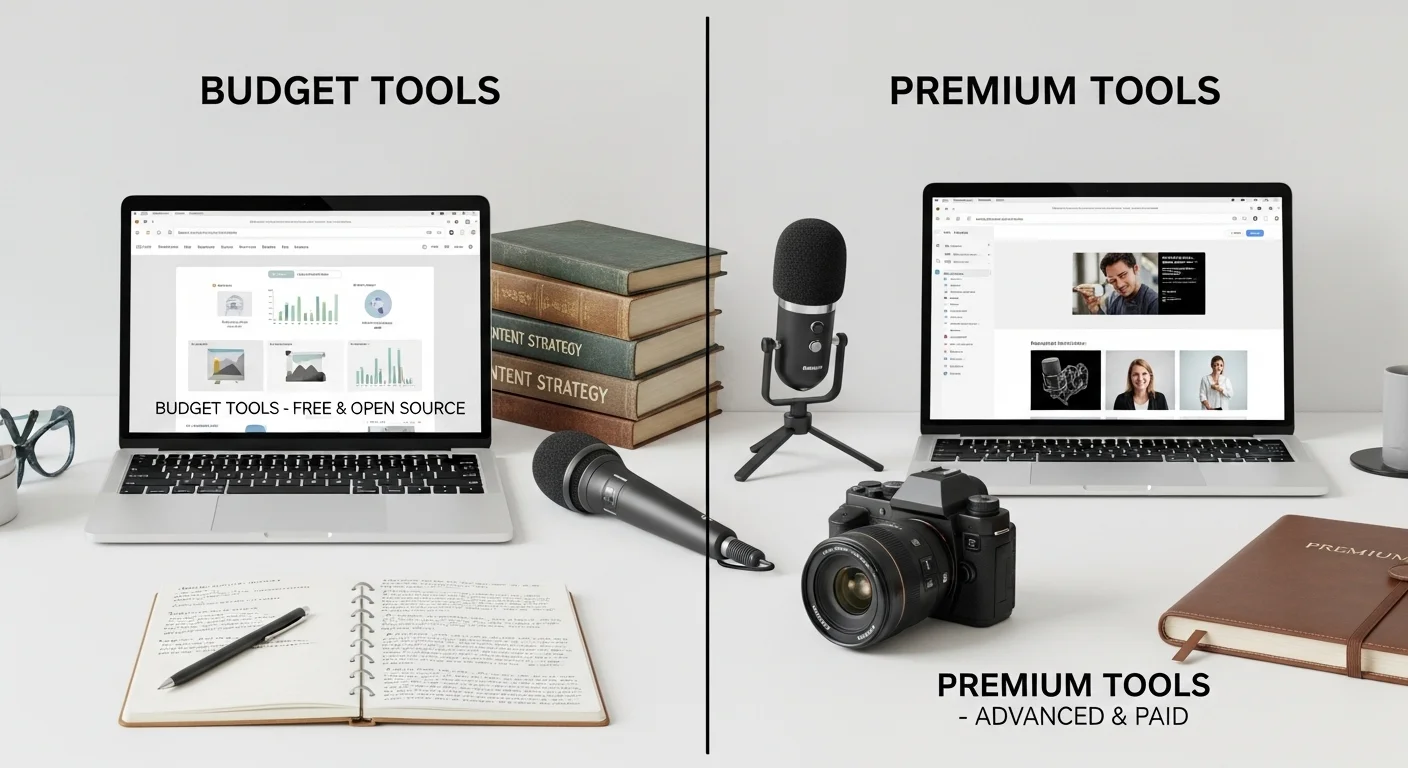
Budget Tools vs Premium Tools, It is a discussion that occurs in nearly all creative studios, start-up offices and even home offices of freelancers. One of us picks up some free or low priced substitute to some high priced software and asks, Why are we paying that much when this will do the same thing? It’s a fair question. And, truthfully, the question is rarely as straightforward as that premium is better and free instruments are as good.
I’ve been in situations on both ends. I have seen little teams stretch the limits of budgeting tools and I have heard of businesses spending money on expensive subscriptions only to utilize 1/10th of the functions. The true solution is to know what you really need – not what will look good on a pricing page.
The Argument in favor of Budget Tools.

Ten years back a free or low cost software implied an interface that was not user-friendly, restricted exportation, and watermarked everywhere. That is no longer the case to a great extent. Programs such as Gimp, the free edition of DaVinci resolve, the free option of Canva, the basic section in Trello and the free version of LibreOffice have grown up. They deal with actual workloads of actual professionals.
One of my friends operates a small content agency -three of them, regular customers, good revenue. They have been using both free Canva and Google Workspace and the free version of Notion. Their customers were not aware. The productions were professional, the deadlines were met and the business was running well.
Budget tools are bright in the following circumstances
- Businesses in their early stages, which are unable to afford the minimum software subscriptions of $300/month until they become financially stable.
- Workers who handle their own work and do not require the collaborative enterprise capabilities.
- The learners and students developing skills without the need to produce at production levels.
- Easy, routine jobs that do not need sophisticated automation and connectivity.
- The monetary case is actual as well. The difference between a free version of a design tool and the paid one is significant, especially when you are a solo designer and want to use the free one in the work with clients, and the free version of the tool really corresponds to your workflow. Keep putting that in thousands of subscriptions and you are discussing thousands a year.
Budget Tools Breakdown Where.
An example is in video editing. The free version of DaVinci Resolve is impressive indeed. However, once a group of five editors must work together on the same project in real-time, exchange assets without any issues, and use sophisticated color science capabilities, the free-tier will not be sufficient any longer. The Studio version available as a paid version now becomes logical – not because the person desires the fancy functionality but because the workflow needs it.
This is the same case with project management tools. The free plan of Trello works excellently with small and simple projects. Mix in an expanding staff, complicated dependencies, resource allocation requirements and reporting requirements and you begin to hit the wall. You are doing workaround and not working.
Other typical areas of pain with budget tools
- Customer service is low or community-oriented and that is okay until you find yourself in the middle of a deadline and have a problem that is about to cause havoc.
- Limits of integration may cause data silos, which require manual work.
- Free tiers are typically deprived of security and compliance features, which is an actual issue in the healthcare, finance, or legal sectors.
- Scalability is a failure point when the team size or amount of data increases.
High Quality Tools are Not ALways worth it.
The apparent one is Adobe Creative Cloud. It is hard to disagree with those who work as professional photographers, video editors, and graphic designers and do their work with clients every day. Photoshop, Illustrator, Premiere and After Effects are integrated and this in itself is worth the price to heavy users. However, I have heard of many individuals subscribing to the entire Creative Cloud that primarily use Lightroom in their recreational photography. Quite a costly hobby subscription.
Prior to investing in a top-notch tool.
- What are the particular characteristics that warrant this price?
- Are those features to be used regularly by the team?
- Is this co-located with the rest of our stack or does it form a new silo?
- What is the shape of the onboarding curve?
A Model of how to make the Decision.
State out your real workflow. List all of your steps and know where there is friction. The term is friction – not feature lack but actual slows that are time or quality consuming. High quality tools must be very precise on particular areas of friction.
Divide actual cost of free. Free software is not necessarily free. Assuming that a budget tool will require your team an additional four hours per week of time to operate within constraints, and your hourly rate or salary cost is significant, the so-called free tool could be costing you more than a $50/month upgrade would.
The Level Strauss.
Budget tools are not a sham and their selection is not a trade-off – it can be very prudent resource deployment. High-quality tools justified their price when they are solving a concrete, actual problem that cannot be faced with low-cost tools.
The error is to consider one of the categories as a default. Going to free to save money may pay off silently. Going out of status is costly and living in fear is unhelpful and costs money in terms of defaulting.
The tool that suits your real work, really existing habits of your team, and your development path is the best. Such an answer is dynamic and being open-minded concerning your answer is likely to be the most useful habit you can develop.
Frequently Asked Questions
Q: Can you use free tools in the workplace?
A: There are numerous free tools that are in use by professionals. The trick here is to ensure security policies, terms of data ownership and whether the limitations of the tool will impact on your specific deliverables.
Q: What makes me change my budget tool to a high-end tool?
A: When you are continually hitting feature limits, workaround time, or when teamwork and integration are required beyond the free tier.
Q: Does it allow me to use a combination of a budget and premium tool in a single workflow?
A: Absolutely. A hybrid stack is the most effective approach of most successful teams, whereby they invest in high-quality tools to work on major projects, and inexpensive tools to work on minor projects.
Q: Are high-quality tools with a better output?
A: Not automatically. The quality of output is more based on the expertise of the user and workflow rather than the cost of the software.
Q: Can as a freelancer it be worth spending on premium tools?
A: It will depend on your salary, expectations of your clients and the centrality of the tool to your work. In the case where you have saved a lot of time on billable projects using a premium tool, then the ROI usually will justify the cost.
Leave a Reply